For the governance and ERM leader

Move from after-the-fact reporting to decision-aware governance.

Committees, decisions, policies, risks, issues and evidence in one model, so oversight reads the rationale, not a summary of it.

In one sentence

AlignX gives governance and risk leaders one control library, one risk view across the enterprise, and every decision recorded with the authority it was taken under.

Written forChief Risk OfficerHead of Governance and ERMCompany SecretaryInternal Audit Director

The solution

What governance has to hold.

Committee authority

What a committee may approve, at what level, held by whom.

Policies, standards, risks, guidelines. Formal or delegated, enterprise or divisional, with the role that holds it, on the committee's own record.

See the GRC product

Decision log

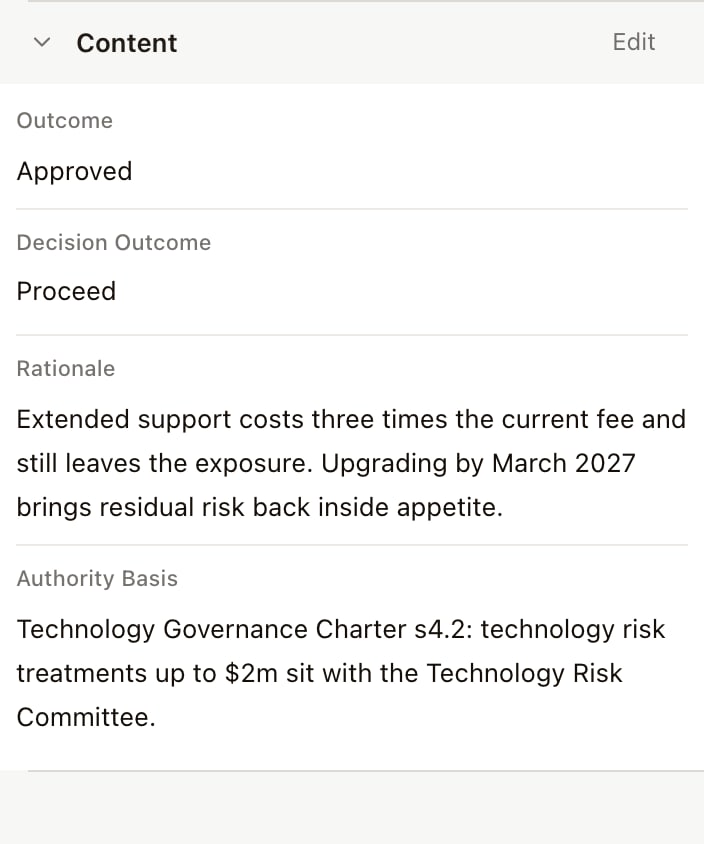
Outcome, authority, and the policy, standard and risk it moved.

Type, status, date, committee and meeting on every decision, so the context behind an approval is one click, not one archive search.

See how it works

Policy lifecycle

A policy with the committee that approved it, its owner and its category.

Not a PDF in a folder. Status, description, approving committee and owner on the record, with the controls and attestations that enforce it.

See the GRC product

Issues and remediation

An audit finding with its owner, its severity and the dates it closed on.

Closed means the retest passed, and the remediation is on the same record as the finding that raised it.

See the GRC product

Risk register

Every risk with its status, its source and its category, in one register.

Treating, assessed, monitoring or closed. Architecture review, audit finding, self assessment or incident. The board pack is a view of this, not a retyping of it.

See the report builder

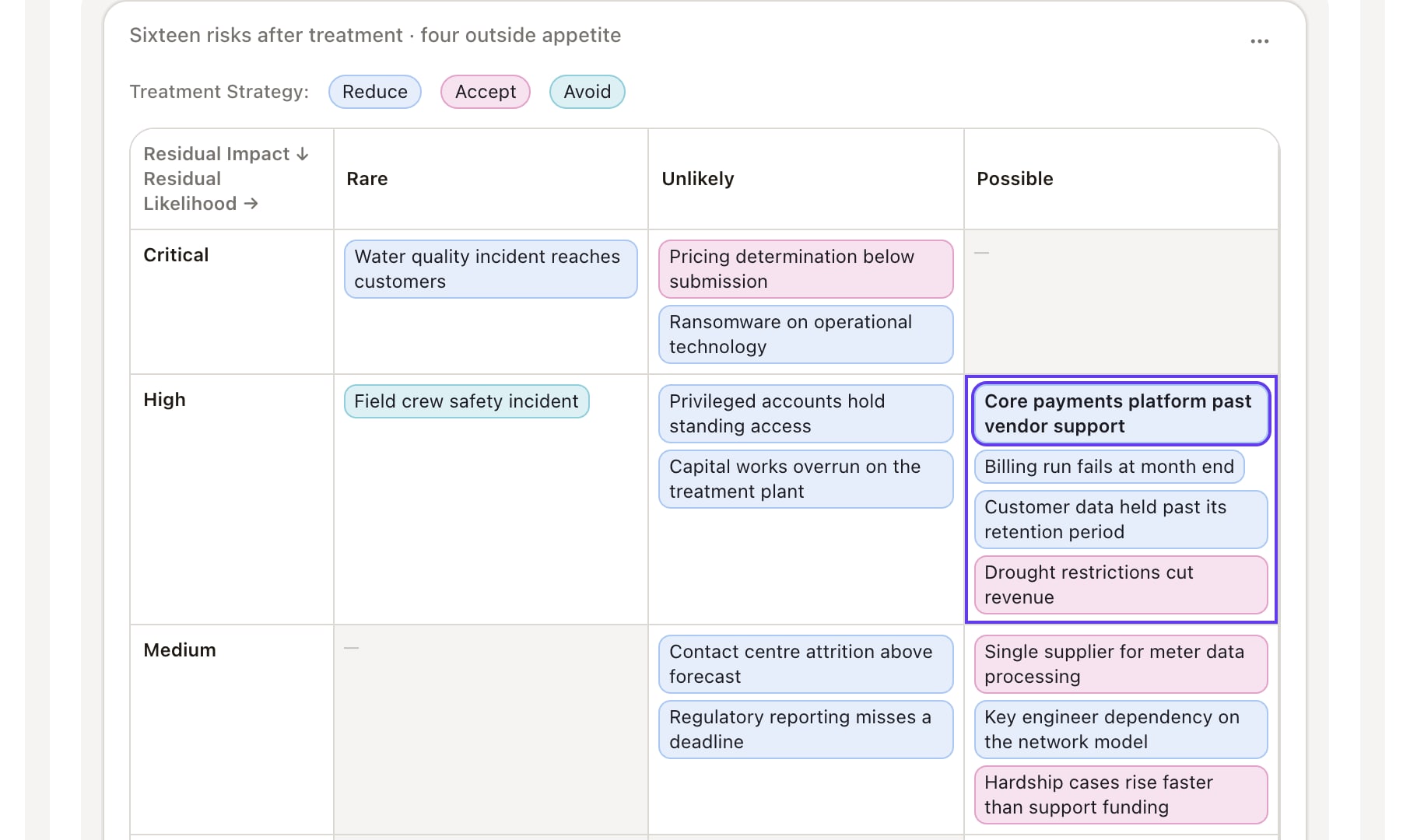
Appetite and tolerance

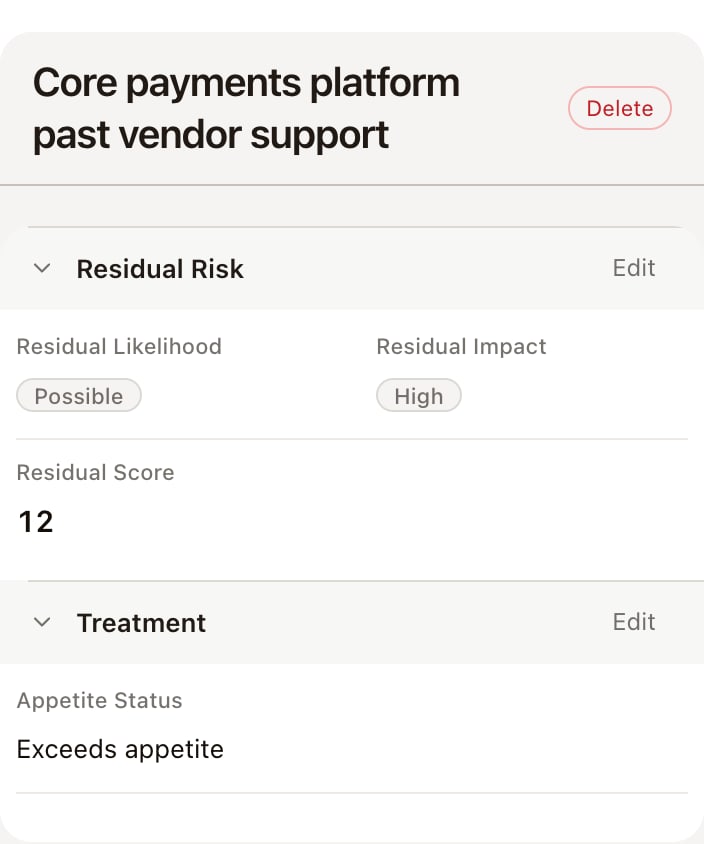
Residual exposure against the band you said you would tolerate.

Twenty-three risks placed on residual likelihood against impact, coloured by treatment. Four still sit outside appetite, and the matrix says which four.

See the GRC product

Day to day

What changes.

Without AlignXWith AlignX
The committee packAssembled from emails the week before, the rationale lost in the summary.
The committee packThe decisions, with their rationale and authority, opened live.
The policy reviewWhich version is current, and who approved it, is a search.
The policy reviewThe policy record carries its status, approver and owner.
The auditA month of gathering evidence from inboxes and shared drives.
The auditThe assessment already holds the evidence, hashed and dated.
The findingClosed when someone says it is closed.
The findingClosed when the retest passes, on the record.
The risk reportA heat map on a slide, three weeks old.
The risk reportA dashboard on the register, scoped and live.
The delegation questionNobody is sure who may approve what.
The delegation questionAuthority is on the committee's record, formal or delegated.

The AlignX technology

Nothing new to govern.

  • Runs inside Microsoft 365In your tenant, on your Dataverse. Nothing leaves it.
  • Entra ID governs who sees whatThe roles you already run decide access. No second directory.
  • Australian data residencyYour Dataverse environment sits in an Australian region. Purview and retention policies apply as they do everywhere else.

How AlignX sits inside Microsoft 365

Questions

What governance leaders ask us.

What GRC, ERM and audit tools does AlignX consolidate or augment?

AlignX brings overall governance and risk management into one enterprise view. Where you run standard GRC/IRM functionality (ServiceNow IRM, Archer, LogicGate, MetricStream), ERM spreadsheets, policy attestation and control testing workpapers, AlignX consolidates them. Where you use a specialised GRC tool for deep category-specific work, AlignX augments and extends rather than replaces. The result is fewer tools, one taxonomy, one source of truth.

Can we retire our current GRC platform and save cost?

For most customers, yes, where the platform is being used for standard GRC functionality that AlignX delivers. Standalone GRC licences (typically 150k to 500k AUD annually depending on scale) come out. Where deep specialised functionality is genuinely used, AlignX integrates and extends. Consolidation usually pays for AlignX within the first year.

How does AlignX handle risk appetite, tolerance and treatment across the enterprise?

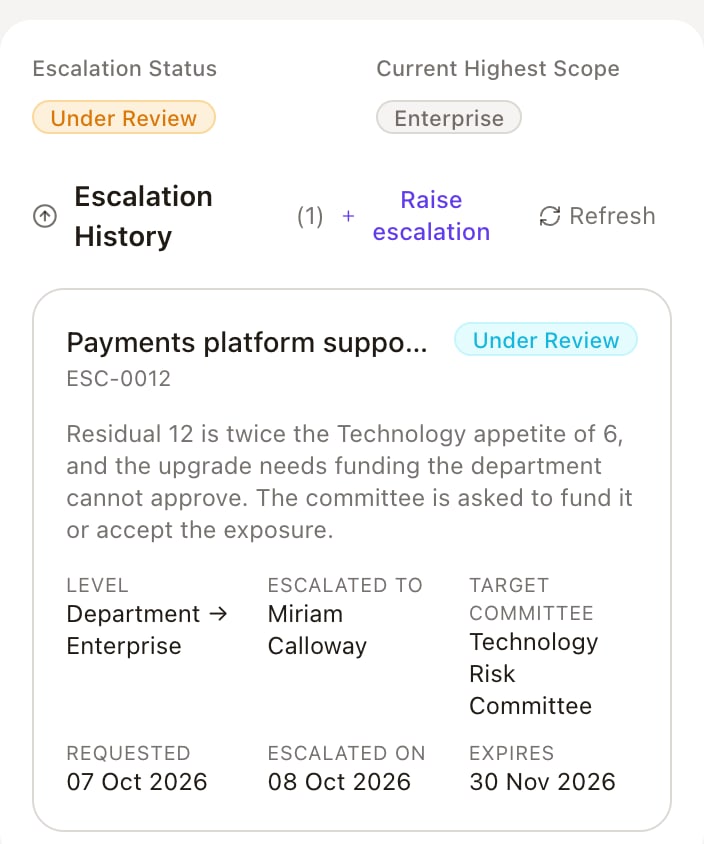
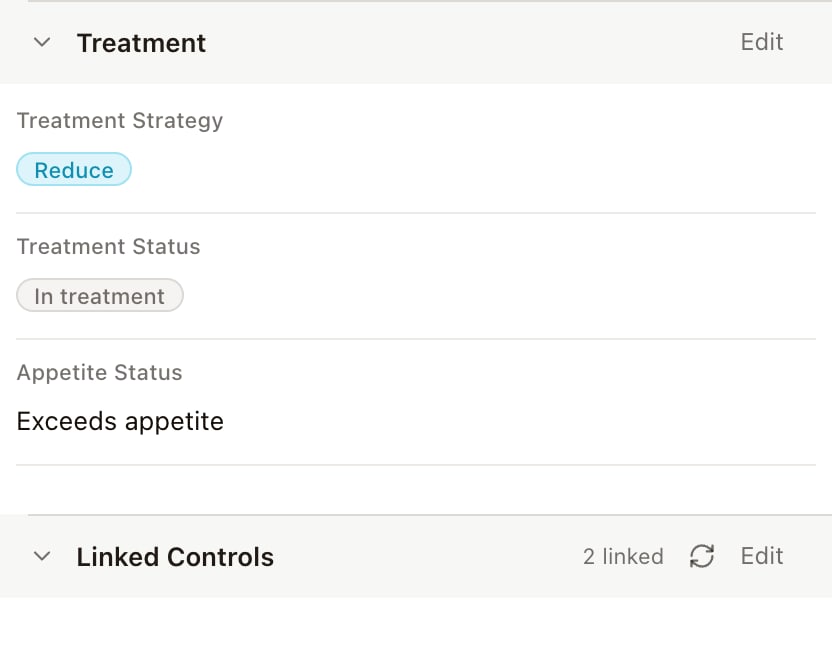
Risk appetite and tolerance are configured per risk category with automated breach detection. Every risk carries appetite, tolerance, treatment strategy (accept, avoid, reduce, transfer) and treatment plan with owner and due date. Appetite breaches escalate automatically to the right forum.

Can we run our risk taxonomy and framework (ISO 31000, COSO ERM) in AlignX?

Yes. Risk taxonomies, likelihood and impact scales, and heat maps are fully configurable to your framework. AlignX ships with ISO 31000 and COSO ERM templates. You configure once, then every risk anywhere in the enterprise uses the same framework.

How do we consolidate risk from finance, cyber, operational, compliance and strategic sources?

All risk categories live in one register with category-specific views. Cyber risks flow in from the CISO workflow, financial risks from finance, compliance from legal, without duplication. Enterprise risk reports the aggregate; category leaders see their slice.

Can boards and audit committees see a live view without waiting for the quarterly report?

Yes. The board risk view is live. Appetite breaches, top risks by residual impact, treatment progress and control effectiveness all refresh on demand. Audit committees get evidence in real time, which shortens their meetings and reduces surprise findings.

How does AlignX handle attestations, controls testing and audit evidence?

Configurable attestation and testing workflows with evidence capture and audit trail. Every control test result, every policy attestation and every audit finding lives on the connected record. When auditors ask for evidence, you filter, export and hand it over in minutes.

See where you stand.

Ten minutes, twenty-one questions, an instant maturity score.